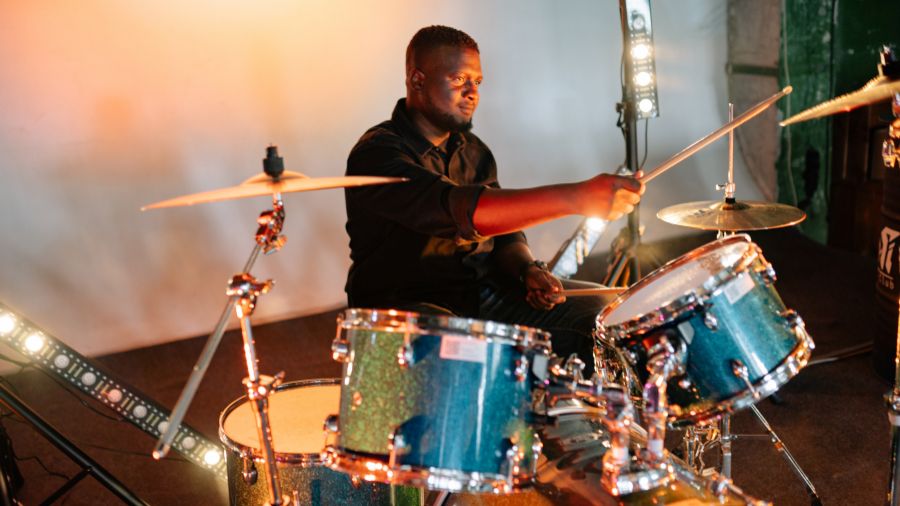
If you’re learning drums, you don’t need a thousand patterns—you need a small set of grooves that show up in real songs. The beats below are pulled from popular recordings across rock, pop, disco, funk, and modern dance styles. Learn these and you’ll be able to sit down at a kit and play along with music fast. The approach is simple: most beats keep eighth notes on the hi-hat and backbeats on 2 and 4. The main changes happen in the kick drum pattern, plus a few feel changes (upbeats, 16ths, openings). Take them one at a time, slow them down, and don’t move on until you can play each groove cleanly.
The 3-Part Drum Beat Formula
Most beginner drum beats follow the same basic structure. The hi-hat usually keeps steady time, often playing eighth notes or a simple variation. The snare drum typically provides the backbeat on counts two and four, which anchors the groove and gives the rhythm its pulse. The kick drum is where most of the variation happens and is often what gives each beat its unique character or “song identity.” If you ever struggle to understand a pattern, step away from the kit and clap the rhythm first—once it makes sense in your hands, it becomes much easier to translate onto the drums.
Beat 1: Basic Rock (Kick on 1 + “& of 3”)
This groove is one of the most common beginner rock beats. The hi-hat plays steady eighth notes counted as 1 & 2 & 3 & 4 &, creating a consistent pulse. The snare drum lands on beats 2 and 4, forming the classic backbeat that drives most rock music. The kick drum plays on beat 1 and again on the “and” of 3, giving the groove its forward push. You can hear this pattern clearly in “You Shook Me All Night Long” by AC/DC, making it a perfect example of the classic rock drum beat every beginner should learn first.
Beat 2: Rock/Pop Variation (Kick on 1 + “& of 2”)
This beat keeps the same core structure as the basic rock groove, with steady eighth notes on the hi-hat and the snare drum striking on beats 2 and 4. The key difference is in the kick drum, which plays on beat 1 and the “and” of 2 instead of later in the bar. That small shift moves the groove forward and gives it a slightly more relaxed, flowing feel while still maintaining a strong backbeat. You can hear this pattern in songs like “Free Fallin’” by Tom Petty and “When Doves Cry” by Prince, showing how a subtle change in kick placement can transform the overall groove.
Beat 3: Driving 8ths (Kick on 1 + “& of 2” + “& of 3”)
This groove keeps the familiar foundation of eighth notes on the hi-hat with the snare drum landing on beats 2 and 4, but the kick drum becomes slightly more active. Instead of two kicks, it plays on beat 1, the “and” of 2, and the “and” of 3, creating a forward-moving feel while still remaining easy to control. That extra kick note adds momentum without making the groove overly complex. You can hear this style of pattern in songs such as “Every Breath You Take” by The Police, “I Will Always Love You” by Whitney Houston, and a variation of it in “Smooth” by Santana.
Beat 4: Rock Variation (Kick on 1 + 2 + “& of 3”)
This groove keeps the familiar structure of steady eighth notes on the hi-hat with the snare drum striking on beats 2 and 4, while the kick drum plays on 1, 2, and the “and” of 3. That extra kick on beat two gives the groove a stronger, driving feel while still remaining simple enough for beginners to control. You can hear this pattern in songs like “Imagine” by John Lennon and in the chorus of “How You Remind Me” by Nickelback. An important lesson with this beat is that a groove should feel solid at both slow and fast tempos, so practice it gradually across different speeds rather than only at one comfortable pace.
Beat 5: Anthem Rock (Add One More Kick)
This groove builds on the standard beginner framework with eighth notes on the hi-hat and the snare hitting on beats 2 and 4, but the kick drum becomes more active, playing on 1, 2, the “and” of 3, and 4. That additional kick note adds extra drive and momentum, giving the beat a fuller and more powerful feel while still remaining approachable for beginners. Variations of this groove appear in rock classics such as “We Will Rock You” by Queen and “I Love Rock ’n Roll” by Joan Jett, showing how a slightly busier kick pattern can make a rhythm sound bigger and more energetic.
Beat 6: Four-on-the-Floor (Kick on 1-2-3-4)
This groove uses the classic “four on the floor” pattern, where the kick drum plays on 1, 2, 3, and 4, while the hi-hat keeps steady eighth notes and the snare lands on beats 2 and 4. The pattern sounds simple, but beginners often find it surprisingly challenging because the kick drum frequently lines up with the hands, requiring precise coordination. You can hear variations of this groove in songs like “Uptown Funk,” “Get Lucky,” “Another One Bites the Dust” by Queen, and “Another Brick in the Wall” by Pink Floyd. The key is to practice slowly at first, focusing on locking the kick and hands together until the groove feels stable and natural.
Beat 7: Disco/Upbeat Hi-Hat Feel
This groove keeps the familiar four-on-the-floor kick pattern on beats 1, 2, 3, and 4, with the snare still landing on beats 2 and 4, but the hi-hat shifts to the upbeats only. Instead of playing constant eighth notes, you count 1 & 2 & 3 & 4 &, striking the hi-hat only on the “&” counts between the beats. That small change instantly creates the light, driving feel associated with disco and dance music. You can hear this style in tracks like “Disco Inferno” by The Trammps, “Party Rock Anthem,” and variations in “Heart of Glass” by Blondie, showing how a simple hi-hat change can transform an otherwise familiar groove.
Beat 8: Double Snare Hit on Beat 2 Feel
This groove keeps steady eighth notes on the hi-hat, but the snare introduces a subtle variation by placing two hits around beat 2, a common technique in pop and soul drumming that adds character without changing the core groove. The kick drum includes an extra hit on the “&” of 4, helping push the rhythm forward into the next bar. You can hear a version of this feel in “Rehab” by Amy Winehouse, where the groove stays relaxed while still sounding detailed and expressive. For beginners, this beat is a great exercise in control—maintaining the solid backbeat while adding an extra snare articulation without disrupting the overall feel.
Beat 9: Disco 16ths on Hi-Hat
This groove keeps the familiar four-on-the-floor kick pattern on beats 1, 2, 3, and 4, with the snare drum striking on beats 2 and 4, but the hi-hat becomes more active by playing steady 16th notes counted as 1 e & a 2 e & a 3 e & a 4 e & a. The faster hi-hat pattern creates a fuller, more energetic texture often heard in disco and pop recordings. Songs such as “Don’t You Want Me” by The Human League feature this feel, while “YMCA” by the Village People uses a variation with open hi-hats on certain upbeats. When learning this groove, focus on keeping the hi-hat smooth and consistent first, then gradually add the snare and kick once the timing feels stable.
Beat 10: Pop/Latin “Island” Groove (The Challenge)
This groove is the most involved of the group, but it appears frequently in modern pop and dance music. The hi-hat plays steady eighth notes, often with slight openings or emphasis on the upbeats to create movement. The kick drum keeps a four-on-the-floor foundation, providing a strong and consistent pulse, while the snare adds accents on the “&” of 2 and the “&” of 4, along with an extra hit placed between the “&” of 1 and beat 2. This combination creates the distinctive rhythmic feel heard in songs like “Despacito” by Luis Fonsi featuring Daddy Yankee, with a similar programmed groove appearing in “Shape of You” by Ed Sheeran. Although this pattern may feel complex at first, many players find it easier once it reaches a moderate tempo, but it’s still important to practice it slowly at the beginning to develop clean and controlled timing.
How to Practice These Beats Fast
When learning a new drum groove, start by clapping the rhythm, especially the kick pattern, before moving to the drum kit. This helps your body understand the timing without worrying about coordination. Once you sit at the kit, begin by playing only the hi-hat and snare until the backbeat feels completely automatic. After that, add the kick drum gradually, keeping your movements relaxed and controlled. Practice the groove at both slow tempos (around 50 BPM) and faster song tempos, since a solid groove should work at different speeds. Most importantly, resist the urge to add fills too early—focus on making the groove feel stable and consistent first.
Explore Real Drums From Around the World

If you want to move from practice beats to real rhythm-making, the right drum makes a huge difference. Our collection features handcrafted drums from cultures around the world, including traditional African djembes, shamanic frame drums, ocean drums, samba drums, and more. Made from natural materials such as wood, animal hide, coconut shell, and metal, these instruments offer powerful sound, authentic character, and a hands-on playing experience that works for beginners and experienced drummers.