Music extends far beyond familiar instruments like guitars and pianos. The world of weird instruments includes devices that create sounds using electricity, water, and even Tesla coils. These extraordinary musical tools challenge our understanding of how music can be made and experienced.
From Benjamin Franklin's glass armonica to the ethereal sounds of the theremin, this article explores ten remarkable musical instruments that push creative boundaries. Each strange instrument represents unique innovations in sound production, featuring unusual playing techniques and distinctive tonal qualities. Get ready to discover some of the most unique musical instruments that have fascinated audiences and composers worldwide.
Theremin

The Theremin is an electronic instrument invented by Russian physicist Leon Theremin in 1920. It is played without physical contact, using two antennas that detect hand movements to control pitch and volume. Its distinctive sound can resemble a human voice or violin, with smooth glissandos and an ethereal quality. The Theremin became especially well known through film scores such as Spellbound and The Day the Earth Stood Still, and has also been used by artists including Led Zeppelin and The Beach Boys.
Glass Armonica
The Glass Armonica was invented by Benjamin Franklin in 1761 after he was inspired by the sound of water-filled wine glasses. It uses 37 tuned glass bowls mounted on a rotating spindle, which are played by touching their rims with moistened fingers. A foot pedal keeps the bowls turning, allowing players to produce soft, sustained and ethereal tones. The instrument became popular in the 18th century and inspired compositions by Mozart and Beethoven, although its unusual sound also led to various myths and superstitions.
Hydraulophone
The Hydraulophone is a unique musical instrument invented by Steve Mann in 2005 that produces sound through flowing water. Players press their fingers over water jets, changing the flow and creating different notes through specially designed channels. Its water jets are arranged like piano keys, allowing players to create melodies and multiple notes at once. Hydraulophones can be found in public spaces, museums, educational settings, and waterparks, where their interactive design makes them accessible to people of different ages and abilities.
Yaybahar
The Yaybahar is an unusual acoustic instrument created by Turkish musician Gorkem Sen. It combines two strings, two frame drums, and long coiled springs that transfer vibrations between them, producing sounds that can resemble electronic synthesizers without using electronics. It can be plucked, bowed, or played by moving along the springs, creating deep, reverberating and otherworldly tones. The Yaybahar has been performed across Turkey and Europe and has also appeared in film and recorded music, including Max Richter's Hostiles soundtrack and Gary Numan's Intruder.
Zeusaphone
The Zeusaphone, also known as a singing Tesla coil, creates music by turning electrical arcs into synthesizer-like sounds. Developed from a modified Tesla coil, it uses controlled electrical discharges to produce musical notes, often through MIDI control. First publicly demonstrated in 2007, the instrument has appeared in performances by Björk and Trans-Siberian Orchestra, as well as films and electronic music. Its dramatic lightning displays make it one of the most visually striking musical instruments ever created.
Otamatone

The Otamatone is a Japanese electronic instrument created in 2009, shaped like a musical note with a smiling face. Players control pitch by sliding their fingers along its touch-sensitive stem, while squeezing the face creates a distinctive wah-wah effect and shaking the instrument adds vibrato. Originally designed as a novelty, the Otamatone has become popular worldwide through social media and online performances, with Deluxe models offering features such as headphone and amplifier connections.
Musical Saw

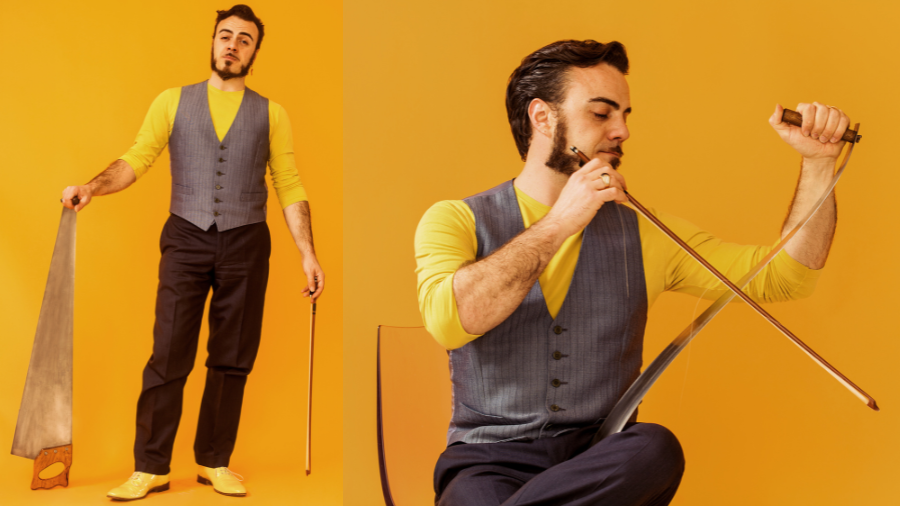
The musical saw turns an ordinary carpenter's tool into an unusual musical instrument. Players hold the saw between their knees, bend the blade into an S-shape, and draw a cello bow across its edge to produce its distinctive sound. Changing the curve and tension alters the pitch. The instrument dates back around 300 years and became especially popular in the 1920s, appearing in vaudeville performances and religious settings.
Its voice-like tone, ethereal resonance, and ability to produce smooth glissandos have also attracted classical composers and film composers, including Dmitri Shostakovich and Aram Khachaturian.
Stylophone

The Stylophone is a pocket-sized electronic instrument that has sold more than three million units since its creation. Players touch a stylus to its metal keyboard, completing electrical circuits that produce its distinctive electronic sound. Made famous by artists such as David Bowie and Kraftwerk, its buzzing tone has appeared across rock, experimental, and electronic music. Modern models add features such as built-in speakers, effects, filters, delay, and MIDI connectivity, making the Stylophone more than just a novelty instrument.
Waterphone

The Waterphone is a strange percussion instrument invented by Richard Waters in 1975, best known for its eerie sound in horror and film music. It consists of a stainless steel resonator bowl surrounded by bronze rods of different lengths, with water inside that changes the instrument's pitch and resonance when moved. Players can bow or strike the rods to create long, haunting tones or percussive sounds. Its distinctive voice has featured in films and television including Poltergeist, ALIENS, Crouching Tiger, Hidden Dragon, and Star Trek: The Motion Picture.
Hang Drum
The Hang is a steel percussion instrument developed by Felix Rohner and Sabina Schärer in Switzerland around 2000. Inspired by steel pan and designed to be played with the hands, it has a distinctive circular shape with tuned notes surrounding a central bass note. Its warm, bell-like tones, rich overtones, and long sustain create a deep, flowing sound that is often used for meditation, relaxation, and sound therapy.