
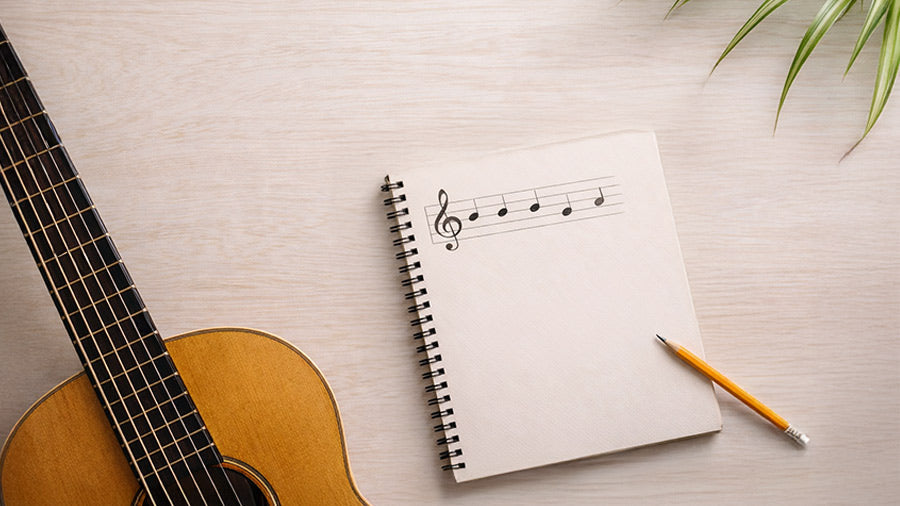
Music theory is the foundation that helps you understand how music works and apply it with confidence. This complete beginner’s guide explains core concepts and how to use them when playing, writing and listening to music.
What is Music Theory?
Music theory is the language of music. It is a set of principles and concepts that musicians use to understand, analyze, and create music. By studying music theory, you will gain a deeper understanding of how music works, including elements such as harmony, melody, rhythm, and structure.
Why Learn Music Theory?
Learning music theory helps you understand how music works, making it easier to play, write, and appreciate it. It strengthens your creativity by giving you tools to build melodies, harmonies, and rhythms with confidence, and helps you break through creative blocks. Music theory also improves listening skills, improvisation, and song structure, benefiting musicians at every level by deepening both practical ability and musical understanding.
The Music Alphabet

The musical alphabet uses seven letters (A–G) to represent notes, repeating from A after G across different octaves. To see how these notes are written and read, explore our How to Read Sheet Music guide.
The 12 Notes of the Chromatic Scale

In 12-tone equal temperament, an octave contains 12 equally spaced pitches: A, A♯/B♭, B, C, C♯/D♭, D, D♯/E♭, E, F, F♯/G♭, G and G♯/A♭. These are pitch classes, not 12 keys: a musical key establishes a tonal centre and typically uses a major or minor scale.
Intervals
An interval is the distance in pitch between two notes. C to C♯ is a semitone, C to D is a whole tone (two semitones), and C to G is a perfect fifth (seven semitones). Intervals may be heard in succession (melodic) or together (harmonic), and they help us understand melodies, scales and chords.
Octaves

Octaves are the next set of the same notes that are either higher or lower in pitch. For example, on a piano, you can play the middle C and can play the same C further down or higher up with a different pitch. Octaves are essential for understanding pitch relationships and transposing music to different keys.
Key Signatures
A key signature tells you which note letters are normally sharpened or flattened in a piece of written music. For example, G major has one sharp (F♯), while F major has one flat (B♭). A key signature alone does not always identify the key, because relative major and minor keys share the same signature.
Scales and Modes
A scale is an ordered collection of pitches, often presented ascending or descending. Major and minor scales are common foundations for melodies and harmony; modes provide other characteristic patterns and tonal centres.
Major Scales

The major scale is one of Western music's most common and widely used scales. It has a bright and uplifting sound. The major scale follows a specific pattern of intervals: whole-whole-half-whole-whole-whole-half, represented by the formula W-W-H-W-W-W-H. The C-major scale consists of the notes C, D, E, F, G, A, and B.
Minor Scales
The minor scale has a darker and more emotional sound than the major scale. Like the major scale, the minor scale follows a specific pattern of intervals: whole-half-whole-whole-half-whole-whole, represented by the formula W-H- W-W-H-W-W. The minor scale has three variations: harmonic, natural and melodic.
Scale Degrees
Scale degrees number the notes of a scale from 1 to 7. In major keys, their traditional names are tonic, supertonic, mediant, subdominant, dominant, submediant and leading tone. In natural minor, the seventh degree is usually called the subtonic because it sits a whole tone below the tonic.
Music Modes
Modes are scale patterns defined by their intervals and tonal centre. The seven diatonic modes are Ionian, Dorian, Phrygian, Lydian, Mixolydian, Aeolian and Locrian. For example, D Dorian uses the same notes as C major (D–E–F–G–A–B–C), but D functions as its tonal centre; simply playing C major from D does not establish D Dorian unless the music treats D as home.
Harmony and Chords
Harmony describes how notes sound together. A chord is a group of notes heard as a harmonic unit, often three or more distinct pitches. Chord tones can be played simultaneously or spread out as an arpeggio. Open and closed voicings describe how widely chord tones are spaced, not whether they are played together or separately.
Triad Chords
Triads are the most basic chords and consist of three notes: the root, the third, and the fifth. A root note is the starting note of the chord, the third is a specific interval above the root, and the fifth is another interval above the root. Triads are the building blocks for more complex chords.
Seventh Chords
Seventh chords add a fourth note on top of the basic triad. They provide additional richness and complexity to the harmony. There are different types of seventh chords, including major seventh, minor seventh, dominant seventh, diminished seventh and half-diminished seventh chords.
Major Chords

Major chords have a bright and happy sound. They consist of a root note, a major third, and a perfect fifth. The C major chord is made up of the notes C, E and G. Major chords are commonly used in various genres of music and are essential for understanding harmony.
Minor Chords

Minor chords have a darker and more somber sound compared to major chords. These types of chords include a root note, a minor third note, and a perfect fifth. For example, a C-minor chord would have the notes C, E♭, and G. Minor chords are widely used in various genres, including classical, jazz, and pop music.
Practise Music Theory with Our Virtual Piano

Put your new skills into practice with our free virtual piano. Explore notes, experiment with scales and play simple chords directly in your browser.
Diminished Chords
Diminished chords have a tense and dissonant sound. They have a root note, a minor third, and a diminished fifth. For example, a C diminished chord consists of the notes C, E♭, and G♭. Diminished chords are often used to create tension and suspense in music.
Augmented Chords
Augmented chords have a unique and unsettled sound. They consist of a root note, a major third, and an augmented fifth. For example, a C-augmented chord consists of the notes C, E, and G#. Augmented chords are less commonly used than major and minor chords but can add interesting colour to a chord progression.
Chord Extensions
Extensions such as the ninth, eleventh and thirteenth add colour beyond a basic seventh chord. For example, Cmaj9 adds D to the notes C–E–G–B. They are useful when you want richer harmony without changing the underlying chord function.
Chord Inversions
A chord inversion is a variation of the same chord. They involve changing the order of the notes while retaining the same pitches. Inversions add variety and smoothness to chord progressions. The most common inversions are the first inversion, where the third becomes the bass note, and the second inversion, where the fifth becomes the bass note.
What is Melody?
A melody is a combination of notes that are played in sequence to create a musical phrase. It is often the most memorable and recognizable part of a song. Melodies can be produced with instruments or vocals and are made up of two or more notes that sound pleasing together.
Melodic Motion
Melodic motion refers to the movement between notes in a melody. There are two types of melodic motion. Conjunct motion occurs when notes move by whole or half steps, resulting in shorter leaps between notes. Disjunct motion involves larger intervals and larger leaps between notes.
What is Rhythm?
Rhythm is an essential element of music that refers to the timing and duration of notes and rests. It is the human perception of time in music. Rhythm creates a sense of pulse and propels the music forward. It also involves patterns of strong and weak beats and accents placed on specific notes.
Beat and Meter
The beat is the recurring pulse of music; metre organises beats into repeating groups. In 4/4, beat one is usually strongest and beat three often has secondary emphasis, while beats two and four are relatively weaker. An offbeat falls between the main beats; a weak beat is not necessarily an offbeat.
Time Signature and Tempo
The time signature is used to indicate the number of beats per measure. It is represented as a fraction at the beginning of a musical piece. Tempo, however, refers to the speed at which a piece of music is played. It is usually indicated by a BPM (beats per minute) marking.
Syncopation and Accents
Syncopation refers to rhythms that accent or emphasize the offbeats. It creates a sense of anticipation and adds a syncopated or "off-the-beat" feel to the music. Accents, on the other hand, refer to the intensity or emphasis placed on specific notes. Accented notes are played with more force or emphasis than unaccented notes.
Voice Leading and Counterpoint
Voice leading and counterpoint describe how multiple musical lines work together. Voice leading focuses on smooth, logical movement between notes in different voices to create clear, pleasing harmony. Counterpoint builds on this by combining two or more independent melodies that interact and support each other, adding depth, texture, and complexity to a piece of music.
What are Chord Progressions?
Chord progressions are sequences of chords that create the harmonic foundation of a piece of music, supporting melody and rhythm. Musicians often use Roman numeral analysis to understand these progressions by identifying each chord’s role within a key, making it easier to transpose and recognise common patterns. Effective chord progressions also rely on good voice leading, where notes move smoothly between chords, creating a natural flow and more pleasing, connected sound.
Musical Dynamics and Expression
Musical dynamics and expression shape how music feels and communicates emotion. Dynamics control volume and intensity, ranging from very soft (pianissimo) to very loud (fortissimo), adding contrast and depth to a performance. Musical expression combines dynamics, articulation, and phrasing to convey mood and meaning, while phrasing groups notes into natural, flowing musical sentences that make a piece feel intentional, expressive, and alive rather than mechanical.
How to apply Music Theory
Music theory is applied by using its principles to make better musical decisions. In songwriting and composition, it helps you build strong chord progressions, melodies, harmonies, and clear song structures. In performance and improvisation, it improves awareness of harmony and form, allowing for more confident playing. In arranging and production, music theory guides instrument choice, harmony placement, and balance which ensures all musical elements work together smoothly and effectively.
Applying Music Theory to Different Instruments
Music theory applies to every instrument, although the way you use it varies. The piano keyboard is often used to explain theory because its layout makes notes, intervals and chords easy to see, but the same principles apply elsewhere. On guitar, chord voicings help with smoother transitions; on bass guitar, root notes and fifths support the harmony; and on ukulele, different strumming patterns change the feel of a progression. Choose one concept and practise it on your instrument to turn theory into playing skills.
Practise Music Theory with Children
Children can develop music theory skills through simple, hands-on activities. Start by clapping a steady rhythm and asking them to copy it, then play or sing two notes and let them identify which is higher. Next, use three notes, such as C, D and E, to create a short melody they can repeat or change. Keep sessions short, fun and age-appropriate, with adult supervision when using instruments. These exercises introduce rhythm, pitch and melody before progressing to scales and written notation.
Do I Need Music Theory to Play an Instrument?
You can learn an instrument, improvise and play by ear without studying music theory. Understanding scales, chords and rhythm can help you learn songs faster, play confidently and communicate with other musicians. With regular practice, you can build a foundation in months, but there is always more to learn. Music theory is a creative tool, not a rulebook.
Continue Learning with Carved Plus

Ready to put music theory into practice? Carved Plus gives you access to our growing library of music books, songbooks, lessons and courses, helping you develop your skills across different instruments.