
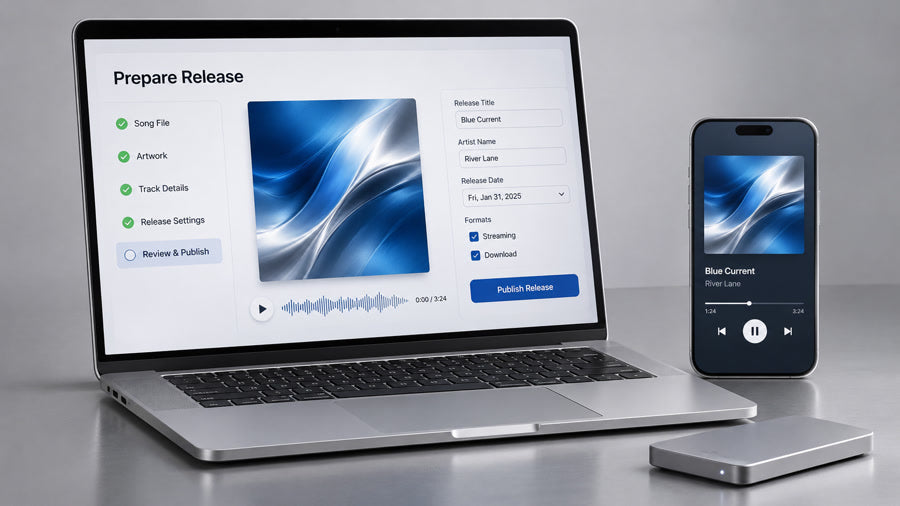
You can release music independently without signing to a record label. Doing it yourself means organising the rights, files, release date and promotion, while choosing the services needed to reach listeners. You can sell downloads directly through your own website or Bandcamp; Spotify requires a distributor. This guide follows a finished recording through preparation, delivery and release, so you know what to do and what to check.
1. Decide Where You Want Your Music Available
Choose whether your priority is streaming, direct sales or both. Streaming services make your recording available where listeners already spend time, while direct sales let fans buy your music. A Bandcamp upload or a download on your own website does not automatically place the song on Spotify or Apple Music. You can combine these routes, provided your agreements allow it. Start with a manageable plan rather than opening every possible account.
2. Confirm the Rights and Credits
Before uploading, record who owns the finished recording and who wrote the music and lyrics, and agree collaborators’ shares in writing. Check permissions for samples, licensed beats, cover songs, guest performances and artwork; buying a beat or recording a cover does not automatically clear every use. Keep the relevant agreements in your release folder. Copyright in the recording and copyright in the composition are separate, so a payment split in a distributor dashboard does not settle every underlying rights question.
3. Prepare Your Release Files
Export the final master in the format your chosen service requests, commonly a lossless WAV file, and listen from start to finish for clipping, unwanted noise or cut-off endings. Keep the original master rather than converting a compressed MP3 back to WAV. Prepare square artwork to the platform’s current specification and a track-information sheet containing the artist name, title, version, songwriters, contributors, explicit-content status and release date. Match spelling and credits across the audio submission, artwork and promotional pages.
4. Choose Your Delivery Route
For streaming distribution, open an account with a provider whose costs and terms fit your release plan; our music distribution comparison explains the main options. You remain the self-releasing artist even when a distributor handles delivery. For direct sales, create your Bandcamp release or set up a secure checkout and digital-file delivery on your website. Running your own shop also means managing payments, customer support and applicable tax and consumer requirements. Direct technical delivery to streaming services is not a simple artist upload route and would involve platform agreements, metadata systems and accounting.
5. Upload and Schedule the Release
Enter the credits carefully, select the correct existing artist profile where applicable and review any automatic store matches. Record the ISRC for each recording and the UPC or equivalent release identifier; your distributor may supply these. If transferring an unchanged recording, follow the new provider’s instructions for retaining its identifiers. Set the release date with enough time for the provider’s review, store processing and corrections. Avoid promising a launch date before checking lead times: an accepted upload is not the same as a release being live everywhere.
6. Prepare Your Artist Pages and Promotion
Once delivery is confirmed, claim the relevant artist profiles and check your biography, image and links. Prepare a simple release page, a short story about the song and a few useful clips or behind-the-scenes posts. Where available, submit an eligible unreleased track for editorial consideration within the platform’s deadline; submission does not guarantee placement. Plan what you will share before, on and after release day so the song has support beyond its upload.
7. Check the Release and Track Your Income
On release day, test playback, artwork, credits, artist-page placement and purchase links. For direct downloads, test the checkout and file delivery too. Save a record of expenses, collaborator payments and royalty statements, and check reporting delays and payout thresholds before expecting income. Your distributor generally accounts for the recording income it receives; songwriting royalties and other rights may need separate registrations or collection arrangements. In the UK, PRS for Music and PPL represent different rights, so check the services relevant to your role rather than assuming one account collects everything.
Take Control of Your Music Release

Become an Independent Artist is our forthcoming guide to preparing and promoting your finished music. Its planned lessons connect artist identity, artwork and release information with submitting through a distributor, creating music videos and promotional clips, and understanding the basics of royalties and Content ID. It is designed to help you organise the work around your release and build a clearer plan for reaching listeners. The book is currently in development.
Coming soon