
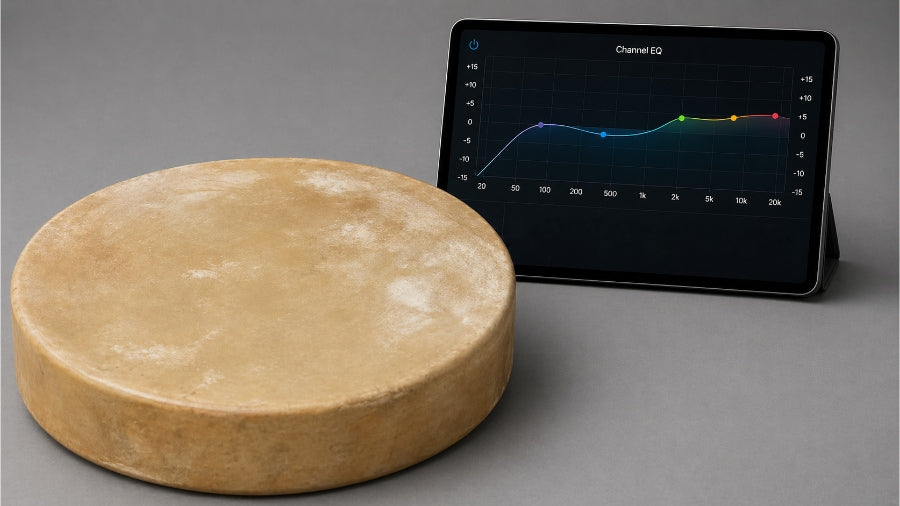
EQ helps drums sit clearly in a mix without losing their natural character. Kick, snare and toms need different treatment from hand drums, while cymbals require careful control of metallic overtones. The frequency ranges below are listening guides, not presets: start with a good recording, identify an audible problem, and make the smallest adjustment that solves it. Always check the result in the full mix.
How to EQ a Shamanic Drum
Shamanic drums depend on deep resonance, natural dynamics and a sustained decay. Only use a gentle high-pass filter if the recording contains sub-rumble, and raise it cautiously while listening to the lowest useful resonance; 30–40 Hz may work for some drums but is not a universal setting. Identify the drum’s strongest body resonance by ear rather than assuming it lies at a fixed frequency.
If it is boomy, try a small, relatively narrow cut at the offending resonance; if it sounds thin, first check microphone placement. Sweep the low mids for boxiness, and make subtle upper-mid adjustments only if the beater lacks definition. Avoid broad high-frequency boosts or heavy compression that flatten the drum’s natural sound. For meditation recordings, preserve a softer, rounded attack; for rhythmic or cinematic arrangements, a subtle upper-mid boost may help the beater stand out.
How to EQ a Kick Drum
Remove unnecessary sub-rumble with a gentle high-pass filter around 20–30 Hz. Look for weight and punch around 50–100 Hz, reduce muddiness around 200–400 Hz if needed, and add a small boost around 2–5 kHz for beater definition. Check the kick alongside the bass instrument so their low frequencies do not compete.
How to EQ a Snare Drum
Start with a high-pass filter around 70–100 Hz to remove rumble without thinning the body. Check 150–250 Hz for warmth, reduce boxiness around 400–800 Hz, and gently emphasise 2–5 kHz if the stick attack needs clarity. A subtle lift above 8 kHz can reveal snare-wire texture; cut harshness rather than automatically boosting brightness.
How to EQ Tom Drums
Preserve each tom’s tuned fundamental, which changes with drum size. A high-pass filter around 35–80 Hz can remove unnecessary rumble, while a gentle cut at 250–500 Hz may control muddiness. Add a little 3–5 kHz only when stick attack is lost. Avoid excessive cuts that remove the resonance needed for full-sounding fills.
How to EQ a Djembe
A djembe combines deep bass, open tones and sharp slaps. Use a high-pass filter around 40–60 Hz to remove sub-rumble; reduce boom around 120–200 Hz and boxiness around 250–400 Hz when audible. A light lift at 1–2.5 kHz can clarify tones, while 4–6 kHz can define slaps. If the top end is fatiguing, gently cut around 7–9 kHz. Record slightly off-axis and listen to a complete rhythm to preserve the contrast between playing techniques.
How to EQ Cymbals
Cymbals and hi-hats contain complex metallic overtones, so avoid treating them like pitched drums. On a dedicated cymbal or hi-hat microphone, use a high-pass filter only as far as necessary to reduce unwanted low-frequency spill; a higher cutoff can be appropriate for close hi-hat tracks, but overhead microphones may also carry the natural body of the whole drum kit. If a crash or ride sounds harsh, sweep roughly 2–6 kHz for the offending resonance and apply a small cut or dynamic EQ rather than broadly dulling the sound. A gentle lift around 8–12 kHz can add shimmer if the recording is genuinely dull, but unnecessary boosts exaggerate hiss and fatigue. Compare the cymbals with the entire kit before deciding on EQ.
How to EQ a Cajon
A cajon combines a low bass thump with higher, snare-like strikes, so listen to both before adjusting EQ. Preserve the low body of the instrument and use a gentle high-pass filter only to remove unwanted rumble; an aggressive cutoff can weaken the bass sound. If the cajon sounds boxy, sweep the low mids and reduce the problem area slightly rather than applying a fixed cut. For more definition in the upper strikes, try a restrained presence lift in the 2–5 kHz region, and soften any harsh snare-wire rattle by ear. If recording with front and rear microphones, check their polarity and phase relationship before EQ, as cancellation can remove low-end weight.
How to EQ Bongos
Bongos have two differently pitched drums, so the smaller macho and larger hembra should not be processed with one rigid frequency preset. Keep the body and tuned resonance of each drum intact, using a high-pass filter only to clear rumble below its useful low frequencies. If the sound is muddy or hollow, sweep the low mids for an unwanted buildup and make a small cut. Gentle emphasis around 2–5 kHz can bring out finger strikes and rhythmic articulation, but too much makes the attack brittle. Balance both drums together, preserving the contrast between their pitches and avoiding over-compression.
How to EQ Congas
Congas produce resonant open tones, warm bass strokes and sharp slaps. Their body and ring often sit around 200–240 Hz, although the exact pitch depends on the drum and tuning; avoid cutting this region automatically. Remove sub-rumble only below the lowest useful tone, then identify any boomy or boxy buildup by sweeping the low mids. A small boost around 4–5 kHz can help slaps stand out when they lack definition, while a narrow cut at an intrusive ringing frequency may improve separation. Listen to the full range of strokes and keep the drum’s natural resonance rather than trying to make every hit sound identical.
Common Drum EQ Mistakes
Do not boost every frequency band or use one preset for every drum. Check microphone placement and room reflections first, make small adjustments, and compare your processed sound with the original recording.
Ready to Go Beyond EQ?

EQ is only one part of music production. Become a Producer introduces rhythms, sound selection, musical layers and arrangement to help you turn ideas into finished instrumentals.


